


Built for R&D Teams
- CAD to working prototype under one purchase order
- Design, DFM, machining, printing, fabrication in-house
- Basic electronics integration — PCB fit, wiring, sensor mounting
- Iteration turnaround typically 2–5 working days
- Minimum 1 piece — no tooling commitment for R&D
- NDA signed before any file is received
- DRDO registered · BDL registered · GeM listed
A Development Partner for Hyderabad's R&D Centres
iMake works with corporate R&D centres, government research laboratories and institutional research groups as a single product development and prototyping partner. From our 7000 sq ft facility at Hardware Park Phase 2, we take a requirement at whatever stage it exists — a concept sketch, a STEP file, or a part that failed last week — and return a working prototype. Design, CNC machining, 3D printing, sheet metal fabrication, silicone tooling and basic electronics integration all happen in-house, under one purchase order and one point of contact.
Research prototypes rarely get it right first time — ours are built for that: minimum order of one piece, no tooling commitment, and a 2–5 working day turnaround per iteration, with your model held between revisions so a revision doesn't start from a blank screen. We can join a project at any stage — concept, CAD, DFM, first prototype, or pilot batch — and carry it through to repeat production without a change of vendor.
Design and DFM — Before Anything Is Cut
Our CAD team works in Fusion 360, AutoCAD and KeyShot, and reviews every design for manufacturability before material is committed — wall thickness, tolerance stack-up, draft angles, fastener access and assembly sequence. If you're starting from a 2D drawing, a scanned part or a hand sketch, we build the parametric 3D model first — so when a sensor changes package or a bracket needs to move 4mm, the model updates rather than being redrawn.


Basic Electronics Integration
Most research prototypes aren't purely mechanical. We handle what sits between a PCB and a finished unit — enclosure design around your board and connectors, mounting bosses, brass heat-set inserts, panel cutouts, cable routing and strain relief, sensor mounting and harness assembly, battery and solar panel mounting. Enclosures are designed to be opened and reworked, since that's what a development cycle needs.
What we don't do: PCB design, firmware or circuit design. You supply the board; we build everything around it.
Confidentiality, Documentation and Procurement
Research hardware is sensitive before it's published or filed. We sign an NDA before receiving any files — your own template is fine — and core machining, printing and fabrication is never sub-contracted.
On procurement: GST invoicing, GeM portal ordering for government departments and PSUs, and inspection reports where your quality system requires them. As a DRDO and BDL registered vendor, qualification for defence-adjacent work is already complete.

Prototype development services for research teams in Hyderabad
Working with R&D engineers, principal investigators and technical procurement teams across Hyderabad's research corridor — from defence labs at DRDL, RCI and CMSD, to HITEC City and Fab City innovation centres, to Genome Valley life sciences — iMake takes a requirement from CAD through to a tested physical unit. Here's how that engagement typically runs.
The development cycle — what happens at each stage
| Stage | What we do | What you get back | Typical time |
|---|---|---|---|
| 1. Requirement review | NDA signed, technical discussion, constraints and success criteria captured | Scope note, approach, quotation | Same day to 2 days |
| 2. CAD and DFM | Parametric 3D model, tolerance and material decisions, manufacturability review | STEP / IGES model, drawings, DFM notes | 2–7 working days |
| 3. First prototype | Fastest suitable process — usually 3D printing for form and fit, machining where function demands it | Physical parts or assembled unit | 1–5 working days |
| 4. Iteration | Your test feedback applied to the held model, parts remade | Revised parts, updated model | 2–5 days per revision |
| 5. Engineering prototype | Production-intent materials and processes, electronics integrated, assembled and finished | Working unit, inspection report on request | 1–3 weeks |
| 6. Pilot batch | Repeatable low-volume production, fixturing where needed, batch inspection | 5–500 consistent units with documentation | 2–6 weeks |
1 piece
Minimum order — no tooling commitment
2–5 days
Typical turnaround per iteration
10+
In-house CAD and DFM engineers
NDA
Signed before any file is received
R&D sectors we work with in Hyderabad
| Sector | Typical prototype work | What usually matters most |
|---|---|---|
| Defence research laboratories | Test rigs, housings, mounting hardware, ground support fixtures | Vendor registration, traceability, confidentiality |
| Automotive & industrial automation | Test fixtures, bracketry, sensor mounts, end-effectors, jigs | Dimensional accuracy, repeatability, fast turnaround |
| Semiconductor & electronics hardware | Reference design enclosures, RF fixtures, thermal test hardware, demo units | Tight tolerances, NDA, small quantities |
| Scientific & medical instrumentation | Instrument housings, sample holders, optical/fluidic fixtures, device prototypes | Chemical compatibility, precise fits, confidentiality |
| Hardware startups | Proof of concept, investor demo units, first production run | Cost per iteration, speed, design support |
Choosing the right process for a prototype
One of the most common questions from research engineers is which process to use for a given stage. Our answer depends on what the prototype has to prove. A rough guide:
| If the prototype must prove… | Best process | Why |
|---|---|---|
| Form, fit, layout, ergonomics | FDM 3D printing | Cheapest and fastest route to a part you can hold — often same or next day |
| Fine detail, smooth surfaces, small features | SLA or DLP printing | 25–28 micron resolution for optical, fluidic and presentation-quality parts |
| Load, precision, real material behaviour | CNC machining | Real metal or engineering plastic to ±0.01mm — no layer-line weakness |
| Enclosures, panels, chassis, frames | Sheet metal and laser cutting | Production-realistic construction at prototype quantities, no tooling |
| Seals, gaskets, soft or flexible components | Silicone tooling | Shore OO to Shore D from 1 piece, without injection tooling cost |
| Repeatability across a batch | CNC milling with fixturing | Consistent dimensions across 5 to 500 units with batch inspection |
Why R&D teams in Hyderabad work with iMake
- Every process in-house — one PO covers design through to finished prototype
- DRDO & BDL registered, GeM listed — qualification already complete for defence-adjacent work
- Material certificates and inspection reports available where your quality system requires them
- Hardware Park Phase 2 — a short drive from the DRDO cluster, Fab City and Genome Valley, so parts can be collected same-day
Start a project: Send your requirement to info@imake.in. A short description of what the prototype has to do is enough to begin — CAD files are welcome but not required.
Some of our recent product development work

Solar-Powered IoT Enclosure
Enclosure with a top-mounted solar panel charging in roughly 5 hours and running an LPWAN device for up to 30 days — developed against the client's power and size constraints for container tracking.
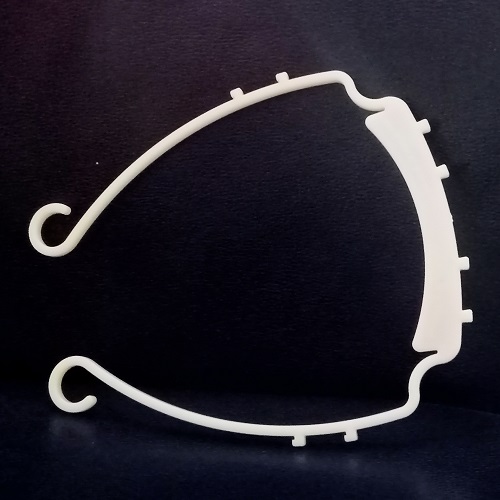
Retractable Safety Hook
Hands-free door and object handling device — spring-loaded mechanism designed, prototyped and taken through to ABS and Nylon moulded parts with a non-corrosive steel spring.
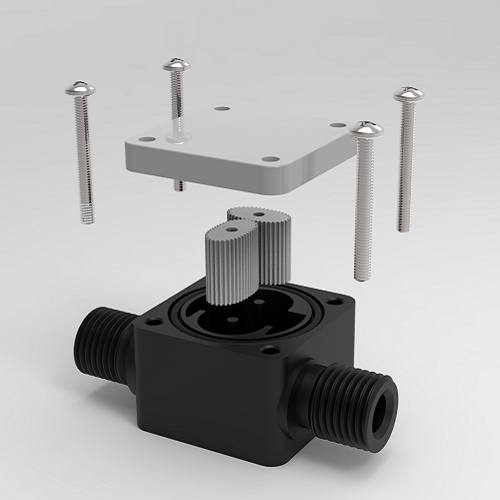
Valve Assembly
Multi-part valve assembly developed through several revisions — machined and printed components fitted and function-checked before the design was released.

Remote Mould Development
Moulds developed remotely for a client's product line and delivered within weeks — the full cycle managed over email and file exchange without an on-site visit.
Not sure which process fits your part?
Use the iMake Process Finder — answer 3–5 questions about what you need and we'll recommend the right manufacturing process, with a pre-filled WhatsApp message to start your quote.
F.A.Q
Frequently Asked Questions
-
We have a requirement but no CAD model. Can you still start?
Yes. A written description of what the prototype has to do is enough to begin. Our 10-person CAD team builds the parametric 3D model from your specification, a hand sketch, a legacy 2D drawing, a PDF, or an existing physical part. Roughly half the product development projects we take on start without a usable 3D model. We will confirm the design intent with you before any material is committed.
-
Will you sign an NDA before we share our design files?
Yes, and we prefer to. We sign an NDA before receiving any files or technical information, and we can work from your organisation's standard NDA template rather than asking you to accept ours. Our team members are individually bound by confidentiality agreements, all CAD work is done on genuine licensed software, and core machining, printing and fabrication is not sub-contracted — your design stays inside our facility.
-
How many design iterations are typical, and how fast is each one?
Most research prototypes settle after two to four iterations. Each revision typically takes 2–5 working days from your feedback to parts in hand, depending on process and complexity. Because we hold your parametric model between revisions, a change request usually means editing a dimension rather than remodelling — which is what keeps iteration cycles short. There is no minimum commitment on iterations; each one is quoted and ordered separately if you prefer.
-
What electronics work do you actually do — and what do you not do?
We do: enclosure design around your PCB outline and connectors, mounting bosses and standoffs, brass heat-set inserts, panel cutouts for displays, switches and I/O, cable routing and strain relief, sensor and camera mounting with defined datums, cable harness assembly, battery compartments, and solar panel mounting and integration. We do not do: PCB layout, circuit design, or firmware development. You supply the board and the electrical requirement; we build the physical system it lives in and make it fit, mount and connect correctly.
-
Who owns the design and the IP that comes out of the project?
You do. Designs, models and any intellectual property arising from work we carry out for you belong to your organisation. We deliver native and neutral CAD files (STEP, IGES, STL, DXF, DWG, PDF drawings and Fusion 360 files) so you are never locked to us as a vendor. We do not reuse client designs, and we do not display client work publicly without written permission — which is why the examples on this page are described by application rather than by client name.
-
Are you registered for government, defence and institutional procurement?
Yes. iMake is a DRDO registered vendor, a BDL (Bharat Dynamics Limited) registered vendor, and is listed on the GeM portal, so government departments, defence PSUs and national laboratories can order directly. We are a registered MSME and issue GST invoices for every order. For vendor onboarding we can supply GST registration, MSME registration, DRDO and BDL vendor references, GeM seller details and bank details on request.
-
Can a project move from prototype to a small production batch?
Yes, and without changing vendor. Once a design is frozen we move it to production-intent processes — CNC milling with proper fixturing, sheet metal fabrication, or silicone tooling for soft components — and produce repeatable batches from 5 to 500+ units with batch inspection and documentation. Because the same team built the prototype, the transfer does not lose design intent the way a handover to a new supplier usually does.
-
What documentation can you supply for our quality system?
We supply material certificates, dimensional inspection reports, process documentation and GST invoices as standard requests. For defence and aerospace-adjacent work we provide the traceability documentation that procurement procedures require. Tell us at quotation stage what your quality system needs — it is easier to record the right data during production than to reconstruct it afterwards.
-
How is product development work priced?
Design and engineering time is billed at ₹1,200–1,250 per hour depending on complexity, or as a fixed project fee agreed upfront when the scope is clear. Manufacturing is quoted per part based on process, material, tolerances and quantity. For multi-stage projects we quote each stage separately so you can approve and budget incrementally rather than committing to the whole programme at the start. A 50% advance is standard for first-time clients; PO-based invoicing applies for institutional accounts.
-
Can our engineers visit the facility or collect parts directly?
Yes. We are at Hardware Park Phase 2, Hyderabad — a short drive from the DRDO cluster, Fab City, Genome Valley and the HITEC City corridor. Research engineers regularly visit to review a part on the bench, discuss a design change in person, or collect finished parts the same day they are completed. For teams further away we ship pan-India. If it helps to walk through the machines and processes before placing a first order, we are happy to arrange a visit — WhatsApp +91-94942-69431 to fix a time.